Introduction
Imagine a world where reading data from files leads you to corrupted bytes, which eventually would reveal themselves to be the result of an extremely interesting chain of coincidencies that brought up to light the unintended interacting behaviour between the Linux Pipe Subsystem and Memmory Management Subsystem (leading to a priv escal).
That is what happened with Max Kellerman, when he disclosed his findings on the
Dirty Pipe (CVE-2022-0847) vulnerability, which allowed basically arbitrary write
on the page cache. This primitive, on that specific memory region, allows for privilege
escalation, corruption of /etc/passwd file, manufacturing ssh keys, sudo hijacking and more.
Accounting it’s impact and low execution complexity, Dirty Pipe was crowned with
a CVSSv3 score of 7.8 (high) by NVD.
So let’s tag along and understand how this was even possible. This post will try to explain the inner workings of each component that lead the vulnerability to work and their relations, by the following structure:
1. Understanding what the vulnerability is
2. Which OS components are involved into
3. How these components work under the hood
4. How they tie together
5. The exploit
For me, this vulnerability is amazing since the moment of its discovery from it’s exploration, not only due it’s simplicity but also by the way it was discovered and researched. In the end, i took the liberty to write some thoughts about the process of the discoverement of the vuln.
What happened? (what it actually is)
Imagine you have those two C programs:
| |
Source: Max Kellermann — minimal reproducer, writer program
| |
Source: Max Kellermann — minimal reproducer, splicer program
Basically, what is happening here is:
-> The first program writes, indefinitely, 5 bytes of data (“AAAAA”) to the “foo” file, which where the program’s file descriptor 1 (stdout) points to in this case.
-> The second program copies the data received from stdin (in this case, the data from foo file)
to it’s stdout, in this case a pipe. This happens through the splice() syscall. And then it also
writes 5 bytes of data (“BBBBB”) to it’s stdout (the pipe).
Given those, one would expect the data from the file to just be redirected by the pipe to another programs stdin (in our case, that would be cat >/dev/null). But in reality, after some time, what happens is:
"Some BBBBB's started appearing at the foo's file"
This should be considered impossible, since in any moment the write happens inside the file. BBBBB is being written into the program’s stdout i.e the pipe. But, in reality, seems like the pipe writes to the foo file, even tho it doesn’t have permissions to do so.
Components involved
So, first of all, let’s see which components and implementations are involved into this strange behaviour.
Separating the experiment onto it’s functionalities we have:
i. A file with data, stored in the hard-drive
ii. A program which reads the file's content and redirects to a pipe via `splice()`
iii. Writes to a pipe previously used
The following questions (processes?) become key for understandment
i. How file data gets transfered to memory for use?
ii. What are pipes and how they get data onto it?
iii. `splice()` behaviour with ( file -> pipe ) data transfer?
iv. How pipes process writes and subsequent writes?
Theory and inner workings
1. Memory
The operating system handles memory via operations on it’s smallest representation unit: a page.
Pages are merely the name that is given for a continous region of 4KiB (4 * 2^10 bytes)
of memory address. Basically, each page carries over 4096 bytes, so 4096 addresses.
In hexadecimal notation that would be 0x1000 bytes.
Page size varies accordantly the CPU architecture (MMU) and OS directives, certain architectures allow for bigger and smaller page size. We are considering here the classical x86/x86-64 (same as RISC-V btw).
When a program reads data from a file for the first time, the kernel copies a number of page chunks from the hard-drive to kernel memory (RAM). The subsystem responsible for storaging and managing those types of pages (file-backed pages) is called the page cache.
From the page cache (kernel memory), the contents inside the loaded pages can then be transfered to userspace or be directly mmap()ed into a process’s address space.
This seems intuitive (and it is, i mean, thats why RAM exists for i.e storing data for CPU to use) but there is an interesting cavenant here:
Not all the syscalls “behave” the same. The way system calls are implemented define how they interact with memory, files, other subsystems, processes and more.
For example, the read() syscall takes a copy from a file’s data and writes it into an specified buffer.
Meanwhile, as Max pointed out on his disclousure, splice() and send_file() are considered zero-copy,
meaning that those syscalls do not make copies of whatever bytes they are transfering, instead
they do it by reference (with pointers!).
2. Pipes
A pipe (|) is a mechanism used by the Linux Kernel (and also a lot of other operating systems / kernels) for transfering data to one end to another in a unidirectional way. Those “ends” being file descriptors.
So, if we have, supposing /tmp/dummy:
| |
Whatever is coming out from ./program1’s stdout (file descriptor 1) is getting transfered to cat’s stdin (file descriptor 0)
This is the basic behaviour of pipes, so now let’s take a look on how pipes are implemented on actual C code.
On Kernel Linux, pipes are implemented as a ring buffer.
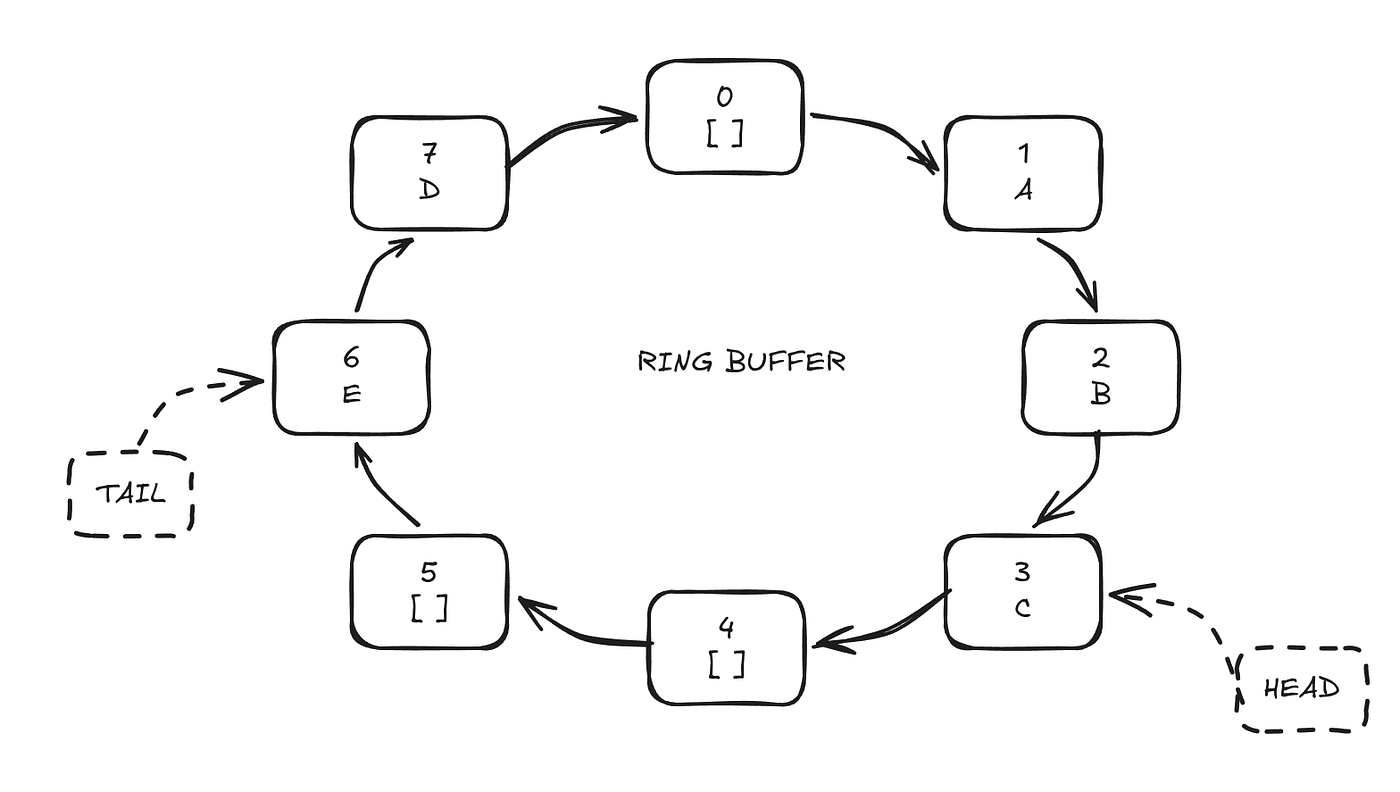
Ring buffers are essentially a circular array buffer. They hold two important integers, head and tail, which are the indexes of the next slot to write
and next slot to read, respectively. For accessing elements on the array, a bitwise AND is performed with a variable called mask
which is ring buffer size - 1. Basically emulating a modulo operation.
The pipe_inode_info struct describe it’s implementation on pipes. As you notice, pipes are represented by
this ring buffer of pipe_buffer structs.
| |
Source: Linux 5.19 — pipe_inode_info (abridged); see Oracle Linux
ring_size is normally 16 on Linux Kernel, meaning 16 pipe_buffer entries.
The pipe_buffer struct is defined as follows:
| |
Source: Linux 5.19 — struct pipe_buffer
The page pointer holds the address containing the page with pipe buffer data.
offset and len define the buffer’s range within the page. offset is the lower bound
for reads on the page, while len, is the number of bytes written and not consumed by a read
on the buffer. When a read is perfomed, the offset field is increased by the same amount len
is decreased, preserving the bytes that still need to be read out the buffer.
One important thing to estabilish is: what is an anonymous pipe? They are pipes that are not backed by a file on the file system, which by consequence, makes them ethereal (they only exists as long as the processes on each end exist).
pipe buffers (the pipe_buffer struct) are called anonymous when the page they reference
is not a page cache entry. When they do not completely fill the page they are writing to,
subsequential writes may append the content to what was already written, instead of allocating
a new page.
This behaviour is attributed to a pipe via the PIPE_BUF_FLAG_CAN_MERGE flag (which is a just a directive
for 0x10), since the checking for the flag is a bitwise operation.
| |
Source: Linux 5.19 — PIPE_BUF_FLAG_CAN_MERGE definition
3. splice() workings
splice() is a linux system call that allows transfering data between two file descriptors where one of them
must be a pipe. As discussed before, transfering data this way, does not make a trip to userland.
Let’s focus on the specific case transfering data from a file to a pipe.
For transfering data from the file to the pipe, splice() invokes a set of functions that are
going to be responsible for setting the page cache sharing operation.
Since page cache data may be non-continous, splice() uses the machinery of the iov_iter interface
to supply arguments and parameters (among them, iterators) to memory management functions that are called by it.
Taking a look at the stack trace for splice():
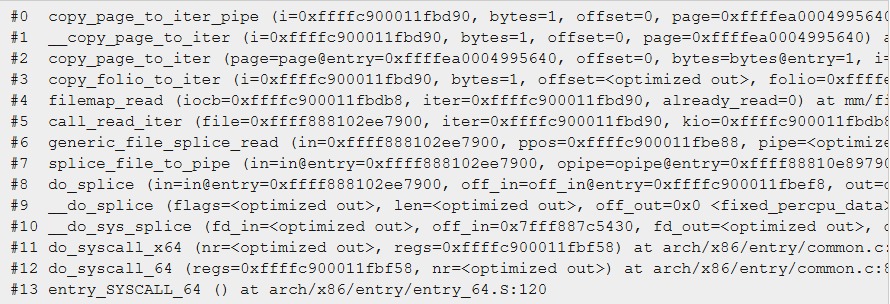
Focusing on the last functions that are called:
- `copy_page_to_iter()`
- `__copy_page_to_iter()`
- `copy_page_to_iter_pipe()`
copy_page_to_iter() is responsible for transfering the data from the page cache pages
in the folio (base page of consecutive pages) to the iov iterator (reference by iter), used by the
pipe for reading the file data.
It calls __copy_page_to_iter() in a loop, handling iov iterator and calls
appropriartly. By the end, copy_page_to_iter_pipe() is called, since is the function that
handles transfers between file backed data to a pipe. It assigns buf->page to the
page cache’s page address, alongside with len, offset and ops.
copy_page_to_iter_pipe() body:
| |
Source: Linux commit 241699cd72a8 — copy_page_to_iter_pipe() (historical implementation)
Seems reasonable and normal, right?
4. Writes to pipes
Writes to pipes are handled by the pipe_write() function. Newer kernel linux versions
split it into two functions: anon_pipe_write() and fifo_pipe_write().
Firstly, it selects the current pipe_buffer struct that is pointed by the head of the pipe, to
check if the pipe is full.
If not, it advances the head and inserts the allocated page into the buffer array (pointed by the head),
as well as setting up its other fields: ops, offset, len and flags.
| |
Source: Oracle Linux — pipe_write() excerpt, Linux 5.19
The bytes written to it are stored on the page it points to, for anonymous pipes, this would be a page similar to an anonymous one.
Remember, all read and write operations on the page are within the range of buf->offset and buf->len.
Subsequential writes to the pipe normally follow the behaviour described above,
advancing the head and setting up fields for the ring slot.
But if the PIPE_BUF_FLAG_CAN_MERGE is set and a write happens the new inserted content
is going to be appended to the page pointed by the pipe_buffer struct, instead of allocating
a new pipe_buffer and moving the ring’s head.
| |
How they tie together
Now, with more information about how things are handled on a lower abstraction level, Lets remember the functionalities that we talked about earlier and relate it to our new knowledge.
i. A file with data, stored in the hard-drive
   |
   |
   |
   |-> file data is loaded on the page cache for use, in our case, we will
       be given a direct reference to its address so we can interact with it.

ii. A program which reads the file's content and redirects to a pipe via `splice()`
    |
    |
    |
    |-> splice() ultimatelly invokes copy_page_to_iter_pipe() to initialize a
        pipe_buffer for storing the contents of the file.

iii. Writes to a pipe previously used
     |
     |
     |
     |-> Writes on pipes happen on the page pointed by pipe_buffer. The behaviour
         of subsequential writes vary depending on the initialized flags on
         pipe_buffer. Is possible for content to be appended if the
         PIPE_BUF_FLAG_CAN_MERGE is setted.
In theory, following what we discussed, everything should be alright and it should not result in unintended behaviour. Everything seems to work, but in one of the assumptions above there is a subtle detail that is the reason why im writing this blogpost.
All said in the above is true and unfortunelly this is also the problem. (or fortunelly, i like this vuln) The atentive reader might have been able to notice, but:
   splice() ultimatelly invokes copy_page_to_iter_pipe() to initialize a
             pipe_buffer for storing the contents of the file.
Checking on all assignments made to the buf variable on copy_page_to_iter_pipe():
| |
Source: Linux commit 241699cd72a8 — copy_page_to_iter_pipe() excerpt
There are no mentions to buf->flag at all, which means that copy_page_to_iter_pipe()
fails at setting flags for the pipe_buffer. Wait, what does this mean for the pipe?
If that instance of pipe_buffer was not previously used, it would have no flags initialized
but if it was indeed used, specially by an anonymous pipe, the flag would still be setted, since
no new value was assigned to buf->flag, overwriting what was previously there.
With this new info we now have:
i. A file with data, stored in the hard-drive
   |
   |
   |
   |-> file data is loaded on the page cache for use, in our case, we will
       be given a direct reference to its address so we can interact with it.
            |
            |------> Page cache reference.

ii. A program which reads the file's content and redirects to a pipe via `splice()`
    |
    |
    |
    |-> splice() ultimatelly invokes copy_page_to_iter_pipe() to initialize a
        pipe_buffer for storing the contents of the file.
            |
            |-----> Persistance of flag allowing subsequential writes to a page
                    on a pipe_buffer.


iii. Writes to a pipe previously used
     |
     |
     |
     |-> Writes on pipes happen on the page pointed by pipe_buffer. The behaviour
         of subsequential writes vary depending on the initialized flags on
         pipe_buffer. Is possible for content to be appended if the
         PIPE_BUF_CAN_MERGE_FLAG is setted.
            |
            |-----> Writes directly happen on the page pointed by pipe_buffer.
Combining it all together we now have an extremelly powerful primitive:
A limited arbitrary write to the page cache.
This would explain why BBBBB’s started appearing on the file! Even though the write is made to a pipe, that pipe holded (somewhere) a reference to the page cache!
The last piece is how to modularized this into a systematic approach in order to exploit it.
The exploit (finally)
Basically we have to manufacture the conditions that we observed from the experiment and achieve by the end:
A pipe with pipe buffers holding a page cache reference, with `PIPE_BUF_FLAG_CAN_MERGE` setted.
With our given machinery, we do have some limitations:
1. Need for read permission on the file, since `splice()` needs it.
2. We can't neither start at / cross a page boundaries from the page cache.
3. The file getting written to can't be enlarged.
Still that’s some pretty decent landscape.
Finally:
    Initiate a pipe
            |
            |
            |
           \ /
            V

   Fill it all with data  ======>  sets PIPE_BUF_FLAG_CAN_MERGE
            |                            on all entries
            |
            |       |----> This only means reading until len = 0
           \ /      |   on all pipe buffer's entrances on the ring.
            V       |        (reads decrement the len index)
                    |
      Drain the pipe     =======> this clears the contents on the
            |                     pipe buffers while leaving their
            |                            flags unchanged.
            |
           \ /       |----> The amount of data is arbritary.
            V        |        Should be at least 1 byte.
      splice data from
       the target file  =======> assigns the page cache reference
        to the pipe              to *page on the pipe_buffer as
            |                    well as buf->offset and buf->len
            |
            |
           \ /
            V
        write data
         into the   =======> Data will be appended to the file page
           pipe              on page cache due PIPE_BUF_FLAG_CAN_MERGE.
                             Effectively writing on the page cache via
                             the target's address.
An interesting fact is: The changes on the file does not necessarily persist, since they are not applied to the file, they are just applied to a copy of the file’s data, stored on the page cache (remember? the kernel copies the data from the disk to the page cache).
In our case, the page is never marked as dirty by the kernel. That happens because, even though the pipe doesnt have write permissions to the file,
Conclusion and author’s thought :D
So if you made it to here: Firstly, thank you for reading it! I hope you understand a little bit more about Dirty Pipe after doing it.
I really enjoyed making this blogpost, as i said at the begginning i really enjoy writing and i appreciatte A LOT when i read something that is well written (clear structure, language, phrasing etc etc).
This was my first time “investigating” a vulnerability. I choose it because i’ve always heard about the Dirty family of vulns but never really “saw” them, so i went to read a little bit about them and selected Dirty Pipe!
As i was reading the discover (which is extremelly well written btw), i was kinda shocked by the way the vuln was perceived. I strongly recommend to read it yourself, not wanting to spoil it but the strange behaviour of the vuln was corrupting couple files from Max’s infrastructure.
Through the discovery, he narrates his process of investigation while explaining how his log server worked. This is interesting because he didn’t instantly betted that it would be a kernel bug, he ruled out enough sources and deconstructed the working setup in order to reach the root cause. I know this reads as a slooped generic phrase but the whole process of changing the angle and reaching dead ends but trading it off for information on the bug
And in the end, he concluded it was a kernel bug by hacking two extremelly simple programs (the ones mentioned on this post) that simulated the core behaviour of his log splitter and his web server! This is what made me like the disclosure so much. Is not the fact that he found the vulnerability itself, but rather the way he did. The fact that he simulated the “important” part of his enviroment behaviour in such a small but precise way which resulted in confirming a kernel bug, for me, it’s amazing.
But anyway people, thanks for reading it i hope i see you around :D